
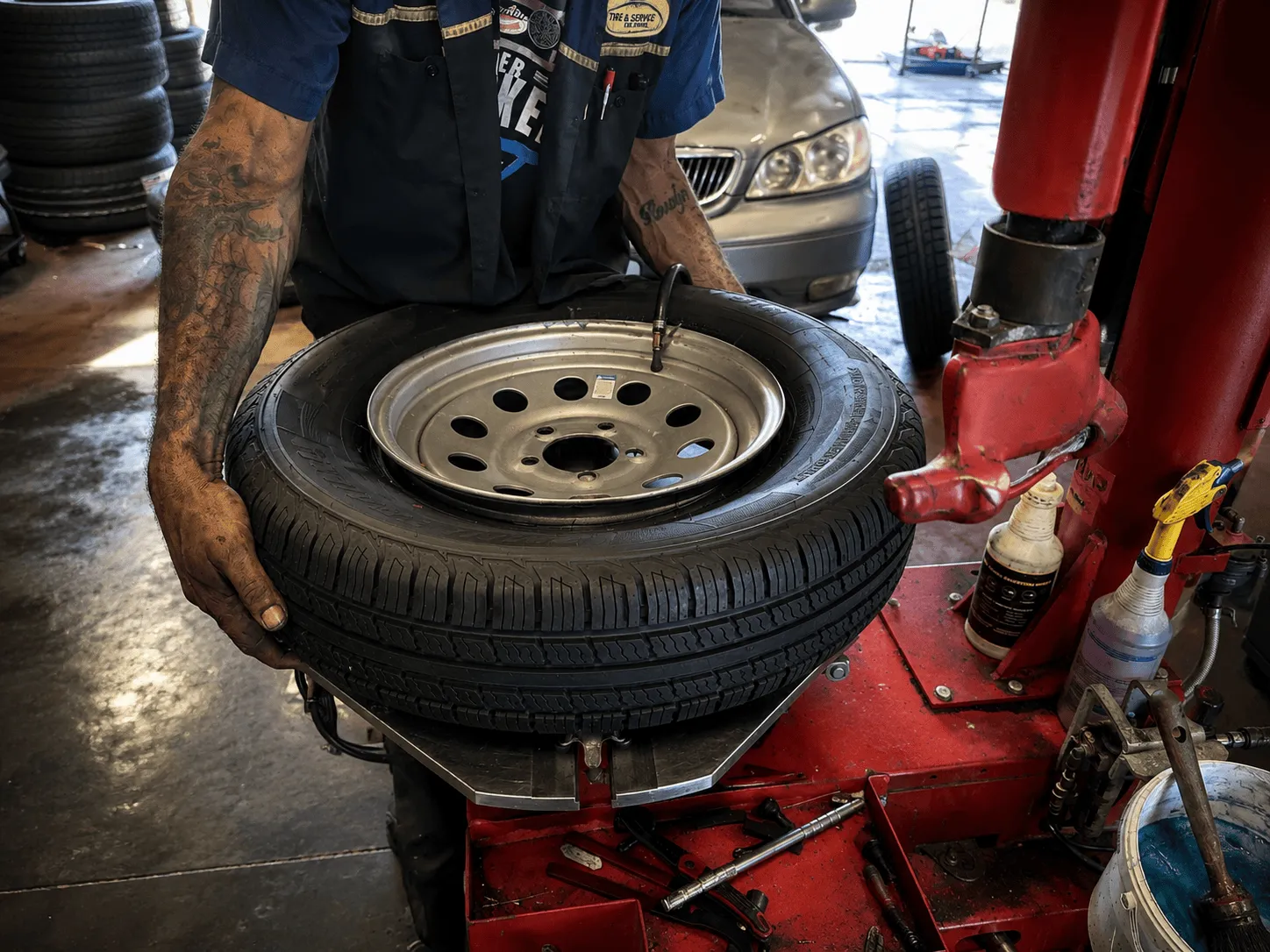
Flat repair in Pearl that saves the tire when the tire can be saved
The fastest way for a tire shop to make money on a nail is to sell you a new tire. We check whether we can fix the one you have first.
Most punctures in the tread area are repairable, and a proper repair costs a small fraction of a replacement. If yours is not repairable, we will show you exactly why, standing at the tire, before we quote you anything.
What a proper flat repair looks like
There is a right way to repair a tire and a wrong way, and most drivers have only ever been given the wrong way.
The wrong way is a string plug jammed in from the outside while the tire is still on the wheel. It takes two minutes, it often holds air, and it does not seal the tire’s inner liner. Moisture works its way into the belts, and the tire fails from the inside months later, usually at highway speed.
The right way, and the only method tire manufacturers actually recognize, goes like this:
- Dismount the tire from the wheel. You cannot inspect what you cannot see.
- Inspect the inner liner. This is where we find damage that is invisible from outside: run-flat scuffing, belt separation, or a second puncture the customer did not know about.
- Ream and clean the injury channel back to fresh rubber.
- Install a combination patch-plug from the inside. The stem fills the hole, the patch seals the liner. One unit, sealed on the correct side.
- Remount, rebalance and reset TPMS. A repaired tire is a different weight than it was. Skipping the rebalance gives you a vibration.
That process runs about $25 to $45 for most vehicles.
When we cannot repair it, and why
We will not repair a tire that is unsafe to repair, and we will not do it because a customer asks us to. The limits are not our opinion, they are industry standard:
- Sidewall punctures. The sidewall flexes constantly. No patch survives it.
- Shoulder punctures, outside roughly the middle three-quarters of the tread.
- Punctures larger than about a quarter inch.
- Any tire that was driven on while flat. Running flat destroys the internal structure even when the outside looks fine.
- Overlapping repairs, or a tire already carrying several patches.
- Tires worn below legal tread depth, because you are about to replace it anyway.
If your tire fails on one of these, we will tell you which one and let you look at it.
TPMS: the light that will not go off
Every vehicle sold in the US since 2008 has tire pressure monitoring, and those sensors have batteries that are sealed inside and cannot be replaced. They last roughly five to ten years and then they die, one at a time.
That means a TPMS light is one of two things: an actual low tire, or a dead sensor. We read all four sensors, tell you which it is, and quote the replacement if you need one. We also service the sensor’s valve stem kit any time we have the tire off, because those seals and grommets corrode long before the sensor does.
Rotations, and why the free ones matter
We check tread depth and set pressures free, on any visit, without an appointment. There is a reason for that beyond being nice.
Rotating tires on schedule, usually every 5,000 to 7,500 miles, is the single cheapest way to get the full mileage out of a set. Front tires on most vehicles wear faster than rears, and left unrotated, you will replace a set at 35,000 miles that had 55,000 in it.
It is also our early warning system. A tire that is wearing on one shoulder tells us your alignment is out. A cupped, scalloped wear pattern tells us a wheel is out of balance or a shock is failing. We would rather find that on a free rotation than after you have burned through new tires.
Serving Pearl, Brandon, Flowood, Richland, Florence and Jackson
We are at 3117 Hwy 80 East in Pearl, minutes from I-20 Exit 48. Punctures come in constantly from the Richland US-49 corridor and from Jackson street debris, along with Brandon, Flowood and Florence.
Bring us the flat
Call (601) 939-6512 before you buy a new tire. If we can fix it, we will fix it.